Bienvenue sur mon blogue du Tour de l'Abitibi. Je suis impliqué depuis 2008 ans dans l'organisation du Tour et je suis opérateur radio-tour durant les courses. J'espère pouvoir vous informer sur le déroulement des étapes, sur les faits intéressants à relater et sur mes impressions de la course et de tout ce qui l'entoure. Étant assis dans la première voiture derrière le peloton, je suis généralement au fait de tout ce qui se passe durant les étapes. J'écrirai donc ici dans les jours précédent le Tour de l'Abitibi et durant toute la semaine que dure le Tour.

Welcome to my blog featuring the Tour de l'Abitibi. I have been involved with the Tour's organisation since 2008 and am the radio-tour operator. I hope to inform readers on the racing during the different stages, on interesting facts during the race and on my general impressions on the Tour an everything that revolves around it. I will therefore start writing on this blog during the few days before the Tour and for the entire week that the Tour lasts for.


samedi 14 juillet 2012

Un peu d'histoire 2e partie / A bit (ibi) of history part 2


Il n’y a malheureusement pas de livre aussi étoffé que « La Route des Champions » de Léandre Normand pour relater l’histoire du Tour de l’Abitibi de 1988 à aujourd’hui. Par contre, M. Normand continue de compiler les résultats du Tour et les a regroupés en 2008 pour le 40e anniversaire du Tour dans un recueil couvrant jusqu’à 2007. La mémoire collective du Tour aide aussi à se rappeler des grands événements dons le Tour a été témoin et qui sont par ailleurs résumés sur le site web officiel du Tour (http://tourabitibi.qc.ca). Reprenons donc notre épopée que nous avions précédemment laissée en 1987…

En 1988, le Tour continue d’élargir ses horizons en accueillant sa première équipe originaire d’Europe de l’Est, la Tchécoslovaquie. Rappelons que le mur de Berlin est tombé en 1989, même année où la Tchécoslovaquie sera redevenue officiellement indépendante de l’URSS. Le pays sera dissout en 1993. Le Tour profitera donc en avance de la disparition du rideau de fer. Bobby Julich, future étoile du cyclisme américain, remporte le classement général pour la première de deux années de domination, principalement à cause de ses habiletés en contre-la-montre.
Bobby Julich
C’est en 1989 que le tracé du Tour, en forme de polygone d’une ville à l’autre, change pour adopter le concept « d’étoile », où chaque étape se termine dans la ville-hôtesse, ce qui facilite grandement la logistique du transport. Ce concept est encore appliqué aujourd’hui. Bobby Julich devance le français Stéphane Heulot au classement général final.

J’avais mentionné dans l’article précédent qu’une femme avait participé au Tour une seule fois, en 1977. Et bien c’était faux. En 1990, l’équipe nationale féminine du Canada participe au Tour. Un club de l’URSS est au départ pour la première fois, autre signe que les temps changent en Europe de l’est. Le québécois Peter Wedge remporte le Tour.

Neuf pays sont représentés pour la première fois en 1991 (Belgique, France, Lithuanie, Yougoslavie, Allemagne, Nouvelle-Zélande, Hollande, États-Unis et Canada). Il s’agira de l’édition la plus rapide du Tour avec une moyenne horaire de près de 46 km/h! Le québécois Steve Rover, coureur dominant au niveau provincial, remporte deux étapes et le classement aux points (maillot orange).
Steve Rover
En 1992, une équipe de Cuba est au départ du Tour, de même que l’équipe nationale d’Australie. L’Ukraine fait aussi son arrivée au Tour. Il est important de mentionner que la région compte de nombreux immigrants ukrainiens venus travailler dans les mines d’or et de cuivre de l’Abitibi dans les années 1930 et 1940. Le canadien Roland Green, futur champion du monde de vélo de montagne, remporte le Tour. Un certain Michael Barry est aussi au départ.
Michael Barry
Une formation d’Amérique du Sud prend le départ du Tour de l’Abitibi pour la première fois en 1993, l’Argentine. Encore neuf équipes nationales sont de la partie, dont la Moldavie et la Biélorussie.

En 1994, le Tour de l’Abitibi fait partie de la Coupe du Monde pour juniors et en est la seule étape nord-américaine, un prélude à la Coupe des Nations des années 2000. Le québécois Guillaume Belzile remporte le classement général devant de puissantes formations comme la Russie, la Nouvelle-Zélande et la Hollande.

En 1995, un cycliste d’élite laisse sa marque sur le Tour en terminant 2e du classement général et en remportant deux étapes, le russe Denis Menchov, qui remporte d’ailleurs en échappée l’étape Rouyn-Noranda-Val-d’Or.
Denis Menchov
Un contre-la-montre par équipes entre Rouyn-Noranda et Virginiatown est organisé en 1996 et il s’agit de la première présence en Ontario pour le Tour de l’Abitibi.

Les États-Unis dominent le Tour en 1997 en raflant le podium final avec la victoire de Josh Thornton, suivi de David Zabriskie et Phil Zajicek, trois futurs professionnels. Josh Thornton remporte trois étapes et le prologue. Pourtant, Zabriskie et Zajicek connaitront des carrières plus en vue que Thornton, qui court aujourd’hui en cyclocross après avoir pris une pause du cyclisme pour prendre soin de sa famille.
L'original Dave Zabriskie


En 1998, Sylvain Richard, actuel responsable du chronométrage sur le Tour, participe pour la deuxième fois. Il terminera 99e à plus de35 minutes du vainqueur après de nombreuses crevaisons, chutes et incidents mécaniques. Il remporte alors le Prix du Courage!

En 1999, le Japon participe pour la première fois au Tour. Cette équipe laissera sa marque sur le Tour au fil des ans, pas seulement pour ses exploits sportifs, mais aussi par son respect, sa gentillesse et ses présentations des coureurs flamboyantes! C’est aussi la première présence de l’Afrique du Sud et de la populaire équipe américaine Hot Tubes. L’américain Rashaan Bahati (Hot Tubes) remporte les deux critériums au programme. Il deviendra un féroce spécialiste de cette discipline aux États-Unis. Le québécois Dominique Rollin termine 4e du général dans le plus long Tour de l’histoire, 648 km.

Rahsaan Bahati, spécialiste des critériums
Le canadien Peter Mazur, courant sous le maillot américain Hot Tubes, remporte le Tour 2000 et deviendra champion de la Coupe du Monde pour juniors et champion du monde junior de contre-la-montre. Rashaan Bahati remporte encore deux étapes et s’empare du maillot orange final.

Un total de dix équipes nationales participent au Tour de l’Abitibi 2001, un record (Afrique du Sud, Allemagne, Danemark, France, Hollande, Italie, Japon, Mexique, Slovénie, Suisse). Le peloton compte les futurs professionnels Tom Veelers et Matti Breschel. Le niveau relevé du peloton relègue le premier canadien à la 26e place au classement général final (Jean-Sébastien Maheux), même  si l’ontarien Ryan Roth remporte une étape.

Le futur sprinteur étoile américain Tyler Farrar remporte le Tour de l’Abitibi 2002, en l’emportant surtout lors du contre-la-montre individuel avec départ sous terre à la Cité de L’Or.

Tyler Farrar et saluant son ami décédé Wouter Weylandt
L’édition 2003 compte 170 coureurs et 29 équipes au départ, un record.
À sa deuxième participation au Tour de l’Abitibi en 2005, David Veilleux remporte le classement général. Il fait maintenant partie de l’équipe professionnelle Europcar.

David Veilleux, au centre, remporte le maillot brun
La Colombie participe au Tour en 2006, malgré un manque total de montagnes en Abitibi! Nous les reverrons d’ailleurs à l’œuvre en 2012.


En 2007, une autre future étoile s’illustre au Tour, l’américain Taylor Phinney qui remporte le classement général final. Il est le fils de Davis Phinney et de Connie Carpenter, deux parents ayant laissé leur marque dans l’histoire du cyclisme américain. Génétique parfaite? Ce pourrait être semblable avec le couple Steffi Graf-Andre Agassi!

La Coupe des Nations est organisée en 2008 pour la première fois en Abitibi afin de célébrer le 40e anniversaire du Tour. Plutôt que d’organiser un seul Tour de l’Abitibi-Coupe des Nations, deux courses séparées sont organisées sur une période de deux semaines! Le jeune sprinteur français Arnaud Démare se distingue particulièrement. C’est aussi en 2008 que le film-documentaire « Le Tour des rêves » est tourné.

Arnaud Démare
De 2009 à 2011, l’UCI autorisera la combinaison des deux épreuves en une seule d’une durée de six jours.
En 2011, après 14 ans avec Val-d’Or comme ville-hôtesse, le Tour de l’Abitibi se rend à Amos. Le retrait de Val-d’Or a bien failli mettre un terme à l’aventure du Tour, repris in extremis par Amos et Rouyn-Noranda.

En 2012, les contraintes organisationnelles et sportives imposées par l’UCI pour la Coupe des Nations rendent cette appellation peu attrayante pour les organisateurs. Le Tour de l’Abitibi devient donc une compétition de sanction internationale de niveau 2.1 pour juniors.  Rouyn-Noranda accueille le Tour pour la première fois depuis 1996. On verra bien quels seront les faits saillants de cette 44e édition…

Unfortunately, no book relating the last 24 years of the Tour de l’Abibiti has been published, such as Léandre Normand’s « La Route des Champions », which concerns the first 20 editions of the race. However, Mr. Normand has compiled all results until 2007 and put them together for the 40th anniversary edition of 2008. The Tour’s website also helped put together the following history of the Tour (http://tourabitibi.qc.ca). Let’s jump in where we left our first part in 2007…

The Tour’s internationality continues to grow in 1988 when the first team from eastern Europe takes part in the race, Tchekoslovakia. The Berlin wall is about to fall in 1989, and Tchekoslavakia will gain a real independence from the USSR in 1989, before the country disappears in 1993. The Tour takes advantage of the new opportunities east of the iron curtain. Future American cycling star Bobby Julich wins the Tour, mostly using his time trialing skills.
Bobby Julich

The Tour’s traditional polygonal, city-to-city course changes to a star-pattern course in 1989. Each stage finish is in the same city, which simplifies transportation and logistics a lot. The concept is still in use today. Bobby Julich wins again in front of Frenchman Stéphane Heulot.

I did write in the previous message that only one woman ever participated in the Tour. Well, that was wrong! In 1990, the women’s Canadian national team takes part in the Tour. A team from the USSR is also part of the field, another sign that eastern Europe is opening up. Quebecer Peter Wedge wins the overall classification.

Nine countries participate in the Tour for the first time in 1991 (Belgium, France, Lithuania, Yugoslavia, Germany, New-Zealand, Holland, USA and Canada). 1991 will be the fastest Tour ever with an average speed close to 46 km/h. Quebec’s junior superstar Steve Rover wins two stages and the points classification (orange jersey).
Steve Rover

In 1992, teams from Cuba and Australia participate for the first time. Ukraine is also on the start line. Of general interest, it is worth mentioning that many Ukrainian immigrants settled down in Abitibi in the 1930s and 1940s to work in the underground gold and copper mines. Canadian Roland Green wins the Tour. He will become a mountain bike champion world champion. Future pro rider Michael Barry is also part of the 1992 edition.
Michael Barry

South America is part of the Tour for the first time in 1993 with Argentina. Nine international teams are on the start line, including Moldavia and Byelorussia.

The Tour is part of the World Cup for juniors in 1994. It is the only North American race to be part of the cup. Quebec rider Guillaume Belzile wins the overall classification in front of cycling powerhouses such as Russia, New-Zealand and Holland.

1995 is of particular interest because a future cycling superstar leaves a permanent impression in Abitibi. Russian Denis Menchov wins two stages, including an impressive breakaway win between Rouyn-Noranda and Val-d’Or.
Denis Menchov

The team time trial ends in Virginiatown, Ontario, for the first time in 1996.

The USA dominates the Tour (again!) in 1997 with a podium sweep. Josh Thornton 1st, Dave Zabriskie 2nd, and Phil Zajicek 3rd, all future pro riders. Zabriskie and Zajicek will pursue successful pro careers, while Thornton takes a pause from cycling to raise his family before returning as a cyclocross racer.
The ever-funny and original Dave Zabriskie


In 1998, Sylvain Richard wins the courage award after finishing 99th, more than 35 minutes behind the overall winner. His misfortunes are numerous and include mechanicals, crashes and punctures. He is the actual timekeeper of the Tour de l’Abitibi. You might meet him at the finish line!

Japan participates in the Tour for the first time in 1999. This team will always leave a deep impression on the Tour with their kindness, respect, sportsmanship and colourful rider’s presentations! South Africa also participates for the first time, as is the case for the popular Hot Tubes club. American Rahsaan Bahati wins both criteriums. He will become a fearless crit specialist in the USA. Quebec’s Dominique Rollin finishes 4th of the overall classification in the longest Tour in history, 648 km.
Rahsaan Bahati, crit specialist

Canadian Peter Mazur, riding for American Hot Tubes team, wins the Tour in 2000, before wiinnin both the junior’s World Cup and the junior’s time trial world championship. Rahsaan Bahati wins two stages again and the orange jersey.

A record ten national teams take part in the 2001 Tour de l’Abitibi (South Africa, Germany, Denmark, France, Holland, Italy, Japan, Mexico, Slovenia, Switzerland). Fuure pro riders Tom Veelers and Matti Breschel are in the peloton. The very competitive field relegates the first Canadian rider to the 26th spot in the overall classification. Ontarian Ryan Roth wins a stage to save the day for Canada.

Futur superstar sprinter Tyler Farrar wins the 2002 Tour de l’Abitibi by crushing the opposition in the individual time trial, which starts underground in a the Cité de l’Or, a former gold mine.
Tyler Farrar salutes his late friend Wouter Weylandt

The largest field ever starts the Tour in 2003: 29 teams and 170 riders.
In its second try at the Tour, Quebec’s David Veilleux wins the general classification in 2005. He is actually riding for pro team Europcar.
David Veilleux, middle, wearing the brown jersey

Colombia comes to Abitibi in 2006, despite a total lack of mountains in the area! They will be back in 2012.

Antoher future star shines in 2007: American Taylor Phinney wins the Tour. He is the son of Davis Phinney and Connie Carpenter, two former elite cyclists. Perfect genes? Maybe. It could also be the case for the offspring of Steffi Graf and Andre Agassi, but that’s another story!


The Tour is the sole North American race of the Junior’s Nation’S Cup for the first time in 2008. Instead of organizing a unique Nation’s Cup-Tour de l’Abitibi race, organizers put together two races over two consecutive weeks! Young sprinter Arnaud Demare shines. The movie “Le Tour des rêves” is shot during the 2008 edition.

Arnaud Démare
From 2009 to 2011, the UCI authorizes the combination of the Nation’s Cup and the Tour de l’Abitibi into one single race lasting six days.

In 2011, after 14 years using Val-d’Or as hosting city, the Tour moves to Amos. The Tour is saved at the last minute by Amos and Rouyn-Noranda after Val-d’Or retired from the organization.

In 2012, rules and regulations imposed by the UCI to organize a Nation’s Cup event grow too heavy and the Tour is now an international 2.1-rated event for juniors. Rouyn-Noranda hosts the Tour for the first time since 1996. We’ll see what happens and who shines during this 44th edition…

mercredi 11 juillet 2012

Un peu d'histoire 1ere partie / A bit of history part 1


Le Tour de l’Abitibi possède une riche histoire et pour cause, 2012 sera la 44e édition consécutive. La majeure partie de cet article est basée sur le livre « La Route des Champions » de Léandre Normand, père fondateur du Tour. Si vous pouvez mettre la main sur ce livre, ça vaut la peine! Les photos de cet article sont aussi tirées du livre. D’ailleurs, M. Normand sera au Tour en 2012. Si vous le croisez (voir la photo ci-bas), dites-lui merci!

Le Tour de l’Abitibi est né en 1969, en tant que rejeton du défi Cyclo-Nordo de 1968 qui comptait seulement trois étapes. La première édition du Tour s’adressait principalement aux coureurs d’âge cadet et junior, mais ces derniers couraient aussi avec des seniors. Une sélection éliminait les meilleurs juniors pour égaliser le calibre du peloton. Cette première édition totalisait huit étapes pour 424km et fut remportée par Gérald Rocheleau du club de Longueuil. Le Tour de l’Abitibi a toujours privilégié les longues distances et les horaires chargés, à défaut d’avoir une topographie favorable pour des étapes de grande difficulté en montagne.
En 1972, le Tour se recentre sur la catégorie junior, mais accepte encore les seniors sous certaines conditions. Le Tour dure alors cinq jours et comporte 8 étapes. Les éditions 1971 et 1972 sont d’ailleurs remportées par nul autre que Éric Van den Eynde, figure bien connue du cyclisme canadien. Voir photo de 1971, Éric Van den Eynde à droite ci-bas.
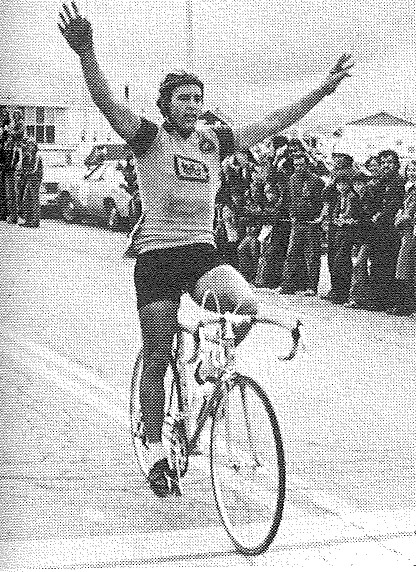
Trois ans plus tard, en 1975, nul autre que Pierre Harvey remportera le Tour, seulement à sa deuxième année de pratique du cyclisme. Un présage du phénomène Pierre Harvey à venir en cyclisme et ski de fond… Voir photo ci-bas.
De 1972 à 1988, le Tour gagne en expérience et en maturité. Les organisateurs ajoutent de nombreuses activités de financement, activités populaires, innovent au niveau des parcours et augmentent la qualité de l’accueil et des services fournis aux équipes. Les villes de l’Abitibi accueillent le Tour en alternance dès 1973. Le sérieux de l’organisation est récompensé d’abord en 1973 par la présence d’équipes ontariennes et américaines, puis en 1977 avec la participation d’équipes de l’ouest canadien. En 1980, l’équipe nationale américaine effectue sa première présence au Tour et en 1981, la première équipe européenne fait son apparition (France), en plus des équipes officielles du Québec et de l’Ontario. L’équipe nationale canadienne fera son entrée au Tour en 1986.
De l’aveu même de Léandre Normand, l’année 1976 fut probablement celle des grands bouleversements qui permirent au Tour de graduer parmi les épreuves d’envergure les mieux organisées, avec l’apparition des différents classements, du maillot orange aux points, de casquettes de leaders du classement par équipes, ainsi que du lancement du journal l’Échappée relatant les faits saillants du Tour. Un total de 103 coureurs était au départ de l’édition 1976, dont un certain Steve Bauer, premier cycliste à porter le maillot orange de l’histoire du Tour (voir photo ci-bas).
Une autre figure bien connue du cyclisme canadien présente sur le Tour 1976 est Louis Garneau, qui terminera en en 5e position sur deux étapes. Voir photo ci-bas.
En 1977, bien qu’une controverse de braquets éclate avec Gary Trevisol et que Lido Crema remporte le classement général, un certain Davis Phinney remporte deux étapes… C’est aussi en 1977 qu’on aperçoit pour la seule fois de son histoire une femme au sein du peloton, Carole Vanier qui avait réussi à convaincre les organisateurs de la laisser participer. Photo de Davis Phinney :
Les éditions 1978 et 1979 seront remportées par Mark Frise, années où se pointeront aussi Gervais Rioux, Matt Eaton et Andy Hampsten.
En 1980, une autre étoile du cyclisme canadien brille en Abitibi. Alex Stieda porte le maillot brun du premier au dernier jour du Tour et remporte le classement général, devant Andy Hampsten qui terminera seulement 7e, faute de montagnes probablement! Photo d’Alex Stieda :
En 1981, la France domine outrageusement le Tour, raflant les trois premières positions au classement général, remporté par Bruno Wojtinek.
1985 marque aussi la domination d’une autre équipe européenne : la Hollande qui voit André van Wijngaarden remporter le Tour. Le géant Hollandais Michael Zanoli, 9e en 1985, reviendra d’ailleurs 1986 en tant que champion du monde junior remporter le Tour de l’Abitibi. Il mourra prématurément d'un infarctus à 35 ans. L’année 1986 comporte d’ailleurs des représentants de sept pays pour la première fois (Canada, États-Unis, Grande-Bretagne, Hollande, France, Suisse et Mexique).
En 1987, l’américain Franck McCormack remportera le Tour, devançant entre autres Jean-Cyril Robin. Le peloton compte alors une équipe de la Guadeloupe!
Depuis 1988, le Tour a continué de s’améliorer et a même fait partie de la Coupe des Nations pour juniors de 2008 à 2011. Le Tour dure maintenant 6 jours et comporte sept étapes pour une distance totale s’approchant habituellement de 600km.


The Tour de l’Abitibi has a very rich history, backed up by 44 consecutive editions. Most of this article is largely based on the book « La Route des Champions » by Léandre Normand, dubbed the father of the Tour. If you can put a hand on this book, it is worth a read. Photographs in this article are also reproduced from the book. Mr. Normand will attend the Tour in 2012, so if you meet him there, please thank him! (Photo of Léandre Normand below)

The Tour de l’Abitibi was born in 1969 as the offspring of the Cyclo-Nordo challenge of 1968, which only lasted for three stages. The first edition of the Tour mostly included U16 (cadet) and U18 (junior) riders, but senior riders were also included. A selection process ensured that stronger junior riders would not ride the Tour in order to smooth the field. The first Tour lasted for 8 stages totaling 424km and was won by Gérald Rocheleau of the Longueuil team. The Tour de l’Abitibi always put the emphasis on distance and stamina, due to a lack of topography to organize mountain stages.
In 1972, the Tour will concentrate on junior riders, but senior riders are still accepted under certain conditions. The Tour lasts for five days and 8 stages. Eric Van den Eynde will win the Tour in 1971 and 1972 before continuing on a cycling carreer to become a famous coach in Canada. Below is a photograph of Eric Van den Eynde in 1971.

Three years later, in 1975, Pierre Harvey will win the Tour in his second season as a cyclist. This was a prelude to his impressive career as a cyclist and cross-country skier. See picture below.

From 1972 to 1988, the Tour will earn experience and maturity. The organizing committee will add numerous fininacing and popular activities and will innovate with new courses while upgrading the quality of the services provided to the teams. Alternating cities will host the Tour starting in 1973. All these upgrades will first pay off in 1973 with the first Ontario-based and American teams, and then in 1977 with the first teams from western Canada. In 1980, the National American team will participate for the first time. In 1981, France will be at the Tour along with the first official Quebec and Ontario provincial teams. The Canadian national team will be at the Tour for the first time in 1986.
According to Léandre Normand himself, 1976 was the year when important changes in the Tour allowed it to become a major race with a strong technical reputation. New standings were created, including the points classification with the orange jersey and the team classification with orange hats. The daily paper l’Échappée was also created in 1976. A total of 103 riders started the Tour that year, including a young Steve Bauer who was the first rider in history to wear the orange jersey (see picture below).

Another famous Canadian cycling authority to be part of the Tour in 1976 is Louis Garneau, who will finish two stages in fifth position. See picture below.

In 1977, despite a controversy concerning the gear ratios of Gary Trevisol and the overall victory of Lido Crema, a young Davis Phinney will win two stages. It is also in 1977 that a woman, Carole Vanier, is allowed to start the Tour for the sole time in the Tour’s history. Photo of Davis Phinney below :

Mark Frise will win the Tour in 1978 and 1979, against riders such as Gervais Rioux, Matt Eaton and Andy Hampsten.
In 1980, one of Canada’s great cyclists shines in Abitibi. Alex Stieda will lead the race from start to end and win the overall classification, while Andy Hampsten will finish in 7th place, probably due to a lack of mountain stages! Photograph of Alex Stieda :

In 1981, France will dominate the Tour with a podium sweep in the overall classification, lead by Bruno Wojtinek.
In 1985, another European team will dominate the Tour : Holland’s Andre Van Wijngaarden wins the Tour. Holland’s giant, Michael Zanoli, 9th in 1985, comes back in 1986 to win the Tour wearing the world champion’s rainbow jersey. He will pass away from a heart failure at age 35. This is also the first time that seven countries are represented in Abitibi (Canada,, USA, UK, Holland, France, Switzerland and Mexico).
In 1987, American Franck McCormack wins the Tour ahead of riders such as Jean-Cyril Robin. A team from Guadaloupe is part of the peloton!
Since 1988, the Tour continued to improve and was even part of the Nation’s Cup for junior from 2008 too 2011. The Tour now lasts for 6 days and 7 stages for a total distance hovering around 600km.


mardi 10 juillet 2012

Plus que 6 jours / Only 6 days left

La 2e conférence de presse a eu lieu aujourd'hui pour annoncer la tenue du Challenge Sprint Abitibi et aussi les équipes qui viendront s'affronter au Tour de l'Abitibi 2012. Le Challenge Sprint Abitibi devrait très excitant. Il s'agit d'un tournoi de trois rondes opposant les sprinteurs des équipes présentes au Tour de l'Abitibi sur une distance de 800 m (2x400 m avec demi-tour à mi-distance). Oui, c'est fortement inspiré du Challenge Sprint tenu en prélude au Grand Prix Cycliste de Québec, mais il faut aussi mentionner qu'il y a quelques années, le prologue du Tour de l'Abitibi était une série de sprints de 400m opposant deux coureurs dans des corridors parallèles, alors le concept est tout de même à moitié abitibien!

En ce qui a trait aux équipes présentes cette année, la liste est au bas de ce message.

The 2nd press conference was held today to announce the Challenge Sprint Abitibi and the teams coming this year to the Tour de l'Abitibi. The Challenge Sprint Abitibi should be very exciting. It is a tournament between the best sprinters of each team from the Tour de l'Abitibi on a total distance of 800 m (2x400 m with a U-turn at the halfway point). Yes, it is strongly inspired by the Challenge Sprint held before the Grand Prix Cycliste de Quebec Pro Tour event, but we must also point out that a few years ago, the prologue to the Tour de l'Abitibi was a series of 400 m sprints between two riders in parallel corridors, so let's say that the concept is half abitibian!


Concerning the teams on this year's Tour, the list is right below.

Canada National
USA National
Thailande National
Guatemala National
Mexique National
Colombie National

IAMGOLD-Abitibi
Québec Provincial
Espoirs Quilicot
Spidertech PB/Powerwatts
Ontario Provincial
British Columbia Provincial (Cycling BC)
Atlantic

Borah Development
ISCorp
Mid-Atlantic Development Foundation
Southeastern Regional
Colavita-Baci
Team Racers Against Childhood Cancer
Young Medalists/Team Rothrock
USA Cycling Development Selection A
USA Cycling Development Selection B
Major Motion Development

mardi 3 juillet 2012

Les stars de demain / Tomorrow's stars

J'écoute le Tour de France sur RDS et j'ai aussi suivi le Giro au mois de mai. Je ne peux pas m'empêcher de penser que l'Abitibi a été témoin des exploits de nombreux cyclistes d'élite au niveau professionnel alors qu'ils étaient juniors. Aujourd'hui, Louis Bertrand prononçait les noms de Denis Menchov ou Tyler Farrar. En mai durant le Giro, c'était Arnaud Demare et Taylor Phinney. Bientôt on parlera sûrement de Lachlan Morton, cet Australien qui avait remporté le Tour avec panache en 2010. Les plus vieux se souviendront aussi de Laurent Jalabert qui avait écumé le bitume abitibien il y a longtemps. Et puis je ne mentionne que les coureurs étrangers. Combien de canadiens et de québécois ont fait un passage quasi-obligé au Tour de l'Abitibi avant de faire carrière pro, semi-pro ou d'aller aux jeux olympiques? Probablement trop nombreux pour les nommer ici. Si je peux mettre la main sur les listes de coureurs de toutes les éditions du Tour de l'Abitibi, ce serait intéressant de faire le palmarès des jeunes loups qui sont venus se faire les dents ici. On verra bien qui se distinguera en 2012... dans moins de deux semaines. J'ai hâte!

I currently watch the Tour de France on TV and I also followed the Giro during the month of May. I can't help but think that Abitibi witnessed the exploits of many of today's pro cyclists when they were racing as juniors. Today, commentator Louis Bertrand was mentioning Denis Menchov or Tyler Farrar. In May during the Giro, it was Arnaud Demare and Taylor Phinney. Soon, it will surely be Lachlan Morton, the Aussie who won the Tour with supremacy in 2010. Older spectators will also remember Laurent Jalabert who also raced on Abitibi's roads. I must also point out that I am only talking about foreign riders. How many canadian and quebecois riders made their almost mandatory stay in Abitibi before pushing on towards a pro, semi-pro or olympic carreer? Probably too many to name here, but it would nevertheless be interesting to get a hand on the complete historical riders listings to see how many famous juniors got their skills sharpened in Abitibi. We'll see who comes on top in 2012... in less than two weeks. Can't wait for it!

vendredi 29 juin 2012

Un nouveau classique / Instant classic

Entendu de la bouche de notre VP technique lors de la conférence de presse de lancement du Tour de l'Abitibi 2012 et repris dans les journaux locaux:
"Ça va prendre des bons pilotes de vélo, pas juste des brutes"! - Bruno Gauthier
À propos du CLMI technique avec parcours étroit et de nombreux virages. On s'en reparle après l'étape 3.

This is a tough one to translate, and it is far less funny in english, but I'll give it a try...
From our VP Technical at the 2012 Tour de l'Abitibi official launch and read in the local papers:
"It will take good bike handlers, not only brute power" - Bruno Gauthier
About the highly technical and narrow ITT course. We'll see about that on stage 3.

vendredi 22 juin 2012

En préparation / In progress

Il ne reste que 3 semaines et demi avant la 44e édition du Tour de l'Abitibi. Qu'est-ce qui se passe côté organisation? Je vais parler pour le comité technique, mais nous venons tout juste de compléter le guide technique préliminaire qui contient toute l'information pour les coureurs et les membres d'équipes. Parcours, cartes, profils d'étapes, descriptions d'étapes virage par virage et tous les sprints intermédiaires, tout y est pour permettre aux équipes de bien se préparer.

600km en 7 étapes sur 6 jours. En Abitibi, on mise toujours sur la distance pour rendre l'épreuve assez dure. Terrain oblige. J'ai beau habiter à Val-d'Or depuis 10 ans, je cherche toujours le val. Cette année, les parcours exploreront le Témiscamingue qui était resté depuis longtemps hors de portée des villes hôtesses précédentes. Je vais enfin voir le barrage d'Angliers! Merci au Tour de m'emmener au Témis! Ça devrait être une étape mémorable. Autrement, on aura des départs à Amos, La Sarre, Malartic, Rouyn et Mont-Brun. Le CLMI sera autour du lac Osisko à Rouyn, sur la piste cyclable. Ça va demander beaucoup d'agilité et de pilotage pour les cyclistes... et les motocyclistes qui ouvriront le parcours! Faudra peut-être bannir les Goldwings... ;-)

The 44th Tour de l'Abitibi is only 3 and a half weeks away. So what's happening with the planning? I can only speak for the technical committee, but we just completed the preliminary technical guide which contains all the practical information for riders and team members alike. Courses, maps, elevation profiles, turn-by-turn detailed description of each stage and all intermediate sprint, everything is in there for teams to prepare adequately.

600km in 7 stages over 6 days. In Abitibi, the race is made difficult by distance because of the topography. I've been living in Val-d'Or (Golden Valley) and am still looking for the valley. This year, the Tour will finally include a stage in Temicamingue. This region was off the schedule for many years due to the distance from past host cities. I will fianlly see the Angliers dam, thanks to the Tour! I am glad that the Tour will finally allow to visit the Temis! It should be a very interesting stage. Otherwise, stages will start in Amos, La Sarre, Malartic, Rouyn and Mont-Brun. The ITT will follow a bike path around Osisko lake in Rouyn. It will be very technical for both cyclists and motorcyclists. Mayben we should ban Goldwings right away... :-)

Bienvenue / Welcome

Bienvenue sur mon blogue du Tour de l'Abitibi. Je suis impiqué depuis 4 ans dans l'organisation du Tour et je suis opérateur radio-tour durant les courses. J'espère pouvoir vous informer sur le déroulement des étapes, sur les faits intéressants à relater et sur mes impressions de la course et de tout ce qui l'entoure. Étant assis dans la première voiture derrière le peloton, je suis généralement au fait de tout ce qui se passe durant les étapes. J'écrirai donc ici dans les jours précédent le Tour de l'Abitibi 2012 et durant toute la semaine que dure le Tour.

Welcome to my blog featuring the Tour de l'Abitibi. I have been involved with the Tour's organisation for the last four years and am the radio-tour operator. I hope to inform readers on the racing during the different stages, on interesting facts during the race and on my general impressions on the Tour an everything that revolves around it. I will therefore start writing on this blog during the few days before the Tour and for the entire week that the Tour lasts for.